
1870: Blood and Iron
Unification of Germany
Directors: Aaron Zhang & Raiden Cheng — Committee Type: Crisis Committee
“It is not by speeches and majority resolutions that the great questions of the time are decided [...] but by iron and blood.”
– Minister-President Otto von Bismarck, 30 September 1862
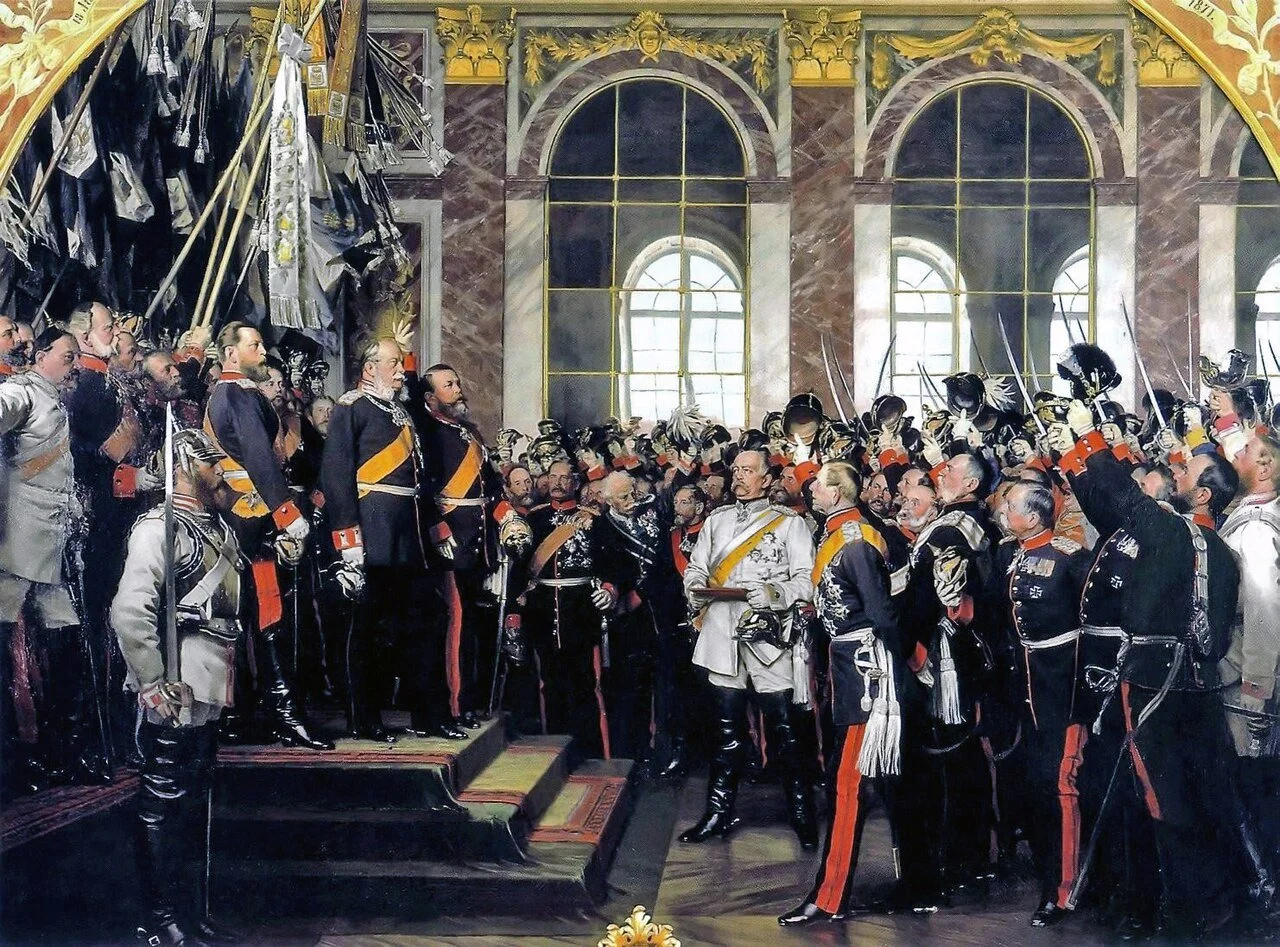
It is now the 16th of July, 1870. Four years have passed since the pivotal Prussian victory at Königgrätz, solidifying its hegemony over all of Germany. Since then, Prussia has relentlessly pursued its aim of German unification, but the flames of war have been ignited once more. The recent publication of a diplomatic communication known as the Ems dispatch had inflamed such patriotic fervour in France that a crowd of nearly twenty thousand gathered in the streets of Paris to demand for war.
Within forty-eight hours, a general mobilization order was issued to the French military, with Emperor Napoleon III personally leading the effort. Now, with the French parliament voting in favour of war with the North German Confederation, the two nations stand on the precipice of a large-scale conflict.
Representing various influential figures throughout Germany, delegates will need to tackle a variety of internal and external issues. The impending war with France presents an opportunity for national unification, similar to what had been achieved by Italy just years before in 1861. This, however, will be no easy feat. Countless cultural differences, faction disagreements, and the fundamental difficulties of directing a nation at war only represent a fraction of the challenges that lie ahead. With the Gallic bull now provoked into a raging fury, it is time for the valiant German bullfighter to decide—will his people emerge unified and victorious, or lie fractured and defeated?
“Centuries have passed since you were last convoked as you have been [...] so entirely as a nation and as Germans [...] Never again will the offer come to you in this way.”
– Johann Gottlieb Fichte, Addresses to the German Nation
-
“As concord makes small things grow, discord brings the greatest to ruin.”
– Sallust, The Jugurthine War
The formation of the North German Confederation following the Austro-Prussian War of 1866 created new challenges for internal administration. With ongoing social reforms in Britain and Russia, it is now time to decide whether or not similar reforms should come to Germany. Questions regarding trade, finances, and the rights of political and religious minorities lie unanswered, with the potential to impact millions of German citizens. Additionally, loopholes in the German political system have allowed for self-centred political maneuvering, and leave the country wide open to destabilization and radicalism. The opinions of the military and civilian population have far-reaching effects, and will have a significant influence on overall decision-making. Given the diversity of political perspectives within Germany, solving these internal issues once and for all will take time, concerted effort, and, most importantly, collaboration.
-
“War is merely the continuation of policy by other means.”
– Carl von Clausewitz, On War
Prussia has been a major party in European affairs for over a century, playing a crucial role in maintaining the European balance of power. With the coalescence of more German states into a single unified polity, there must come a corresponding change in foreign policy. Such a rapid acceleration of unification efforts in Germany over the past decade has been a cause of alarm for many of Europe’s great powers. In the south lie the bitter Austrians, still reeling from their defeat in 1866. To the west stand the hostile French Empire and the neutral Low Countries, and to the east looms the Russian bear. Finally, isolated from the continent on their island, the British harbour a growing degree of discontent with German actions, such as the annexation of Hannover. Managing diplomatic relations with these powers carries the potential for both great benefits and serious costs, yet they nonetheless play a significant role in fulfilling civilian and military aims.